

Bigen Cream Tone is a two-part cream hair color from Hoyu for covering gray hair, with five shades currently available at YUBI100: 3G, 4G, 5G, 6G, and 7G. The practical choice depends on how light or deep you want the brown result to look and whether you need a cream format for targeted application.
| Key information | Verified detail |
|---|---|
| Brand / manufacturer | Bigen / Hoyu |
| Product format | Two-part cream hair color for gray hair |
| Japanese classification | Quasi-drug hair color |
| YUBI100 shades | 3G, 4G, 5G, 6G, and 7G |
| Current Japan-store price | JPY 550–594 depending on shade, checked September 15, 2026; prices can change |
| Most important safety point | Read the enclosed instructions and complete the required skin allergy test before every use |
| Shop | View Bigen Cream Tone shades |
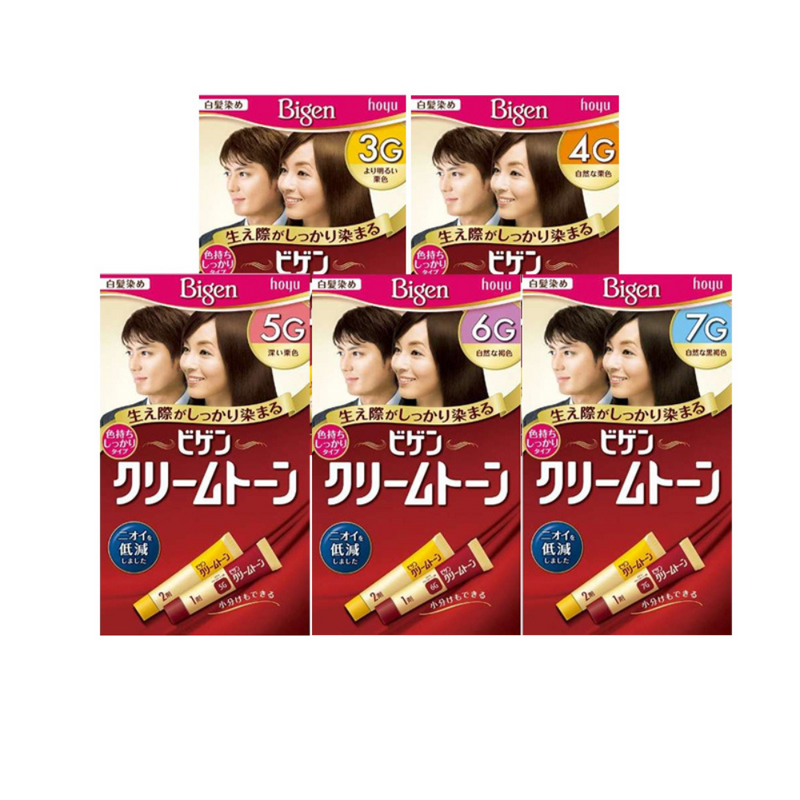
Bigen Cream Tone at a glance
Bigen Cream Tone is part of Hoyu’s long-running Bigen gray-hair color range in Japan. This listing is a cream format made from a first agent and a second agent. The two components are dispensed in equal amounts for mixing, according to Hoyu’s current brand guidance. Hoyu does not sell either component separately, so both tubes should be treated as one matched product system.
The main shopping decision is not whether one shade is universally “best.” It is which of the five listed G-series shades fits the depth you want to buy. The number progression moves from the lighter 3G end toward the deeper 7G end in the YUBI100 selection, while the official shade names distinguish chestnut from brown descriptions. Hair color outcomes can vary with starting color, the amount and distribution of gray hair, previous coloring, hair condition, application, and processing. A printed shade guide is useful for orientation, but it is not a guarantee of an identical result.
This article is an editorial product guide based on the active YUBI100 listing and current Hoyu information. It is not a first-hand wear test, salon consultation, or promise of a particular result. For the current shade menu, price, and stock status, use the Bigen Cream Tone product page.
Five shades compared: 3G through 7G
| Shade | Official shade description | Position in this five-shade range | YUBI100 price checked Sep. 15, 2026 |
|---|---|---|---|
| 3G | Lighter chestnut | Lightest of the five listed options | JPY 550 |
| 4G | Natural chestnut | Between 3G and 5G | JPY 594 |
| 5G | Deep chestnut | Middle of the five-shade progression | JPY 594 |
| 6G | Natural brown | Deeper than 5G in this range | JPY 550 |
| 7G | Natural dark brown | Deepest of the five listed options | JPY 594 |
The labels above describe the manufacturer’s shade naming rather than a prediction for every head of hair. “Lighter” and “dark” are relative to this range. They should not be read as a universal salon level chart or as a promise that previously colored hair will become lighter. If exact matching matters, compare the current box photography and enclosed shade information before use, and ask a qualified colorist when there is uncertainty about prior color, uneven porosity, or a complicated color history.
3G: lighter chestnut
3G sits at the lightest end of the five shades stocked in this listing. Its official English description is “lighter chestnut.” It is the clearest starting point for a shopper who wants to compare the lighter side of the G-series selection, but that does not mean it will lighten every starting base or reproduce the package image exactly. The existing pigment in the hair and the proportion of gray hair can change how a color appears.
4G: natural chestnut
4G is described as “natural chestnut.” Within this five-shade set, it provides a step between lighter 3G and deeper 5G. “Natural” is part of the shade name, not a claim that it is invisible, universally neutral, or suitable for every complexion. Use the number and the box shade reference together when comparing it with neighboring options.
5G: deep chestnut
5G is the middle number in the stocked sequence and is described as “deep chestnut.” It can be considered when 4G appears lighter than the desired direction but the brown names of 6G and 7G appear deeper than intended. The word “deep” describes the shade position; it does not establish a fixed outcome across untreated, previously colored, and gray hair.
6G: natural brown
6G changes the official English naming from chestnut to “natural brown.” It is deeper in the stocked G-series progression than 5G. Hoyu’s current Bigen FAQ also identifies the unmixed first-agent cream for 6G as white, while the second agent is white. That appearance before mixing should not be used as a shade-result guide; the enclosed instructions and shade code remain the relevant references.
7G: natural dark brown
7G is the deepest of the five shades in the YUBI100 listing and is described as “natural dark brown.” It is the option to compare when the shopper is looking at the darkest end of this particular set. “Dark brown” still does not mean a guaranteed match to another brand’s similarly named color, because shade numbering and naming systems are not standardized across every manufacturer.
How to choose between neighboring shades
A useful way to narrow the choice is to compare only neighboring codes first. If 3G looks too light, compare 4G. If 4G looks too light but 6G looks too deep, compare 5G. If 6G is not deep enough for the intended direction, review 7G. This reduces the chance of treating all five brown labels as interchangeable.
| If you are deciding between | Difference to focus on | What not to assume |
|---|---|---|
| 3G and 4G | Lighter chestnut versus natural chestnut | Do not assume either shade will lighten previously colored lengths |
| 4G and 5G | Natural chestnut versus deep chestnut | Do not rely on the word “natural” alone |
| 5G and 6G | Deep chestnut versus natural brown | Do not treat different naming systems as universal color levels |
| 6G and 7G | Natural brown versus natural dark brown | Do not expect an identical result on every starting base |
When deciding, check the exact shade code on the current product page and again on the delivered box. Packaging can be revised over time, and a familiar English color name is not a substitute for the code. If you are buying more than one box for a single application, use matching shade codes and check that the packages belong to the same current product line.
Formula and ingredient status
The verified product format is a two-part cream hair color. Hoyu’s current FAQ confirms that Bigen Cream Tone has a first agent and a second agent and that the two have different viscosities. It advises dispensing equal amounts by considering both the length and thickness of the cream placed in the mixing tray. The company also notes that the first-agent cream color differs by shade: 3G, 4G, and 5G are orange before mixing, while 6G and 7G are white; the second agent is white. These are descriptions of the unmixed creams, not the finished hair color.
| Shade | First-agent active ingredients listed for that shade |
|---|---|
| 3G | 5-amino-o-cresol; p-aminophenol; p-nitro-o-phenylenediamine; p-phenylenediamine; m-aminophenol; resorcinol |
| 4G | 5-amino-o-cresol; p-aminophenol; p-nitro-o-phenylenediamine; p-phenylenediamine; m-aminophenol; resorcinol |
| 5G | 5-amino-o-cresol; p-aminophenol; p-nitro-o-phenylenediamine; p-phenylenediamine; m-aminophenol; resorcinol |
| 6G | p-aminophenol; p-phenylenediamine; m-aminophenol; resorcinol |
| 7G | p-phenylenediamine; m-aminophenol; resorcinol |
Other ingredients listed for the first agent in all five checked variants: HEDTA trisodium solution, PEG-8, PEG-20, polyoxyethylene cetyl ether, polyoxyethylene (2) lauryl ether, polyoxyethylene (21) lauryl ether, ascorbic acid, seaweed extract-1, strong ammonia solution, high-polymer dimethicone-1, stearyl alcohol, cetearyl alcohol, parabens, poly(dimethyldimethylene piperidinium chloride) solution, anhydrous sodium sulfite, petrolatum, and fragrance.
Second agent, HC Oxide (A), common to the five checked variants: the listed active ingredient is hydrogen peroxide solution. Other listed ingredients are propylene glycol, POE (20) POP (4) cetyl ether, POE cetyl ether, isostearyl alcohol, citric acid, steartrimonium chloride, cetanol, and phenoxyethanol.
These are English renderings of the Japanese quasi-drug label terminology checked against current Japanese drugstore listings by JAN code on September 15, 2026. They are not presented as an international INCI list. Formulas and packaging can change, so compare them with the exact ingredient panels on the delivered 3G, 4G, 5G, 6G, or 7G box before use. The physical package remains the controlling source for allergies and ingredient avoidance.
If you have a known sensitivity, need to avoid a specific substance, are pregnant, are receiving treatment, or have questions about whether permanent oxidative hair color is appropriate for you, do not infer safety from a partial online list. Read the complete current Japanese labeling and seek professional advice appropriate to your circumstances.
What the cream format changes
A cream format is especially relevant when a shopper wants to work with a product that is dispensed from two tubes and mixed in controlled portions. The YUBI100 listing describes Bigen Cream Tone as suited to partial coloring, and Hoyu’s present FAQ discusses dispensing equal amounts of the first and second agents. This is a format distinction, not a claim that self-application will always be easy or even.
The first and second agents may not appear to leave the same amount in their tubes even when similar lengths are dispensed. Hoyu explains that the opening size of the first-agent tube and the different viscosities can affect how much comes out. The current guidance says to open the first-agent tube fully with the cap projection and to compare the thickness as well as the length of the two cream portions when measuring equal amounts.
Do not improvise a mixing ratio, replace one component with another product, or purchase one agent from an unrelated kit. Hoyu states that the first and second agents are not sold separately. Keep the components, tray, instructions, and outer box together so that the shade code and safety information remain identifiable.
Safety is part of the product decision
Bigen Cream Tone is a Japanese quasi-drug hair color, so the safety instructions are not optional editorial fine print. Hoyu says to read the precautions and perform a skin allergy test before every use. A previous successful use does not remove that requirement.
Hoyu also gives a stronger warning for anyone who has ever experienced irritation or a reaction from hair color: do not use the product, and do not perform the skin allergy test. This distinction matters. A patch test is not a way to re-check a product after a previous hair-color reaction.
| Before opening the product | Why it matters |
|---|---|
| Confirm the exact shade code | 3G, 4G, 5G, 6G, and 7G are different color options |
| Read the current enclosed Japanese instructions | They contain the product-specific preparation, timing, rinsing, and warning information |
| Check the current ingredient labels | Online summaries may be incomplete or refer to another shade or edition |
| Follow the required skin allergy-test instructions every time | Hoyu requires the test before each use |
| Do not use after any previous hair-color reaction | Hoyu instructs such users not to use hair color and not to perform the test |
| Keep away from eyes and follow all age and health warnings | The package instructions define the applicable restrictions and response steps |
This guide deliberately does not paraphrase a processing time or create a universal step-by-step method. Those details must come from the current instructions supplied with the exact package. Do not substitute a blog summary for the manufacturer’s directions.
Package and cream appearance
Some product concerns can be resolved without making assumptions about the final result. Hoyu notes that a small amount of air can be present in the tubes due to manufacturing and that fill quantity is controlled by weight. It also explains that first-agent hair-color cream can turn partly brown or black when exposed to air; according to the company, this visible change does not affect the finish.
These points apply to the cream’s appearance and packaging, not to suspected damage, contamination, a missing seal, or a package that differs from the ordered shade. If the delivered product appears compromised, do not use it. Preserve the package information and contact the seller or manufacturer for product-specific guidance.
Price and availability in Japan
At the time of this article draft, the active YUBI100 listing showed 3G and 6G at JPY 550 each, while 4G, 5G, and 7G were JPY 594 each. Those are store prices checked on September 15, 2026, not a manufacturer’s recommended retail price and not a promise of future pricing. Stock and price can change independently for each shade.
The same product page groups all five shade options, which makes it important to confirm the selected variant before checkout. A lower displayed starting price may correspond to only some shades. The current Bigen Cream Tone listing is the appropriate source for live selection, price, and availability.
Buying it outside Japan
The product is sold with Japanese packaging and instructions. Buyers outside Japan should make sure they can understand the complete directions and warnings before use. Hair-color products may also be subject to carrier limits, local cosmetics rules, or import inspection, depending on the destination and shipping service.
Do not assume that availability on a Japanese store page guarantees admission into every country. Check the destination’s current personal-import rules and the carrier’s acceptance policy before ordering. Any taxes, duties, brokerage charges, or delivery restrictions can change and are not included as fixed foreign-currency estimates in this guide.
First-hand use notes
Editorial verdict
Bigen Cream Tone is most straightforward to evaluate as a five-shade, two-part cream system rather than as five unrelated products. Start with the shade code: 3G lighter chestnut, 4G natural chestnut, 5G deep chestnut, 6G natural brown, or 7G natural dark brown. Then confirm the current box, price, ingredients, and safety insert before use.
The cream format and neighboring shade progression make the range easy to compare on paper, but the article does not claim a tested result, guaranteed gray coverage, wear duration, odor level, or universal ease of use. The most important unresolved publication item is the current full ingredient list for every stocked shade. Until that is verified and the pre-publication review passes, this article must remain unpublished.